
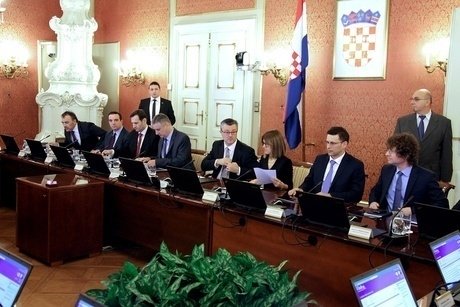
The revenues of the state budget for 2016 are planned at the level of 113 billion kuna, while expenditures are set at 120.4 billion kuna, resulting in a deficit of approximately 7.5 billion kuna, or 2.2 percent of GDP, as outlined in the Guidelines for the Preparation of the State Budget for this year, adopted on Thursday at the Government session.
If off-budget funds and the consolidated budget of local governments are added, the deficit for this year is expected to total 9.2 billion kuna, or 2.7 percent of projected GDP, and even according to Eurostat’s ESA 2010 methodology, it would not exceed 3 percent of GDP, emphasized Finance Minister Zdravko Marić at the session.
The guidelines are based on a projection of economic growth this year of 2 percent.
– For this year, we expect a slight acceleration of economic growth to 2 percent, primarily due to the contribution of domestic demand, said Marić, adding that a contribution to growth is also expected from net exports, i.e., faster growth of exports than imports.
He pointed out that these projections are very close to the projections of the European Commission. The Commission recently raised its estimate of Croatia’s GDP growth this year from the previous 1.4 to 2.1 percent.
– The projections are realistic. Until now, it has been the practice to inflate macroeconomic projections, and based on that, the revenue side of the budget. This has not proven to be a good strategy, he asserted.
This year, a slight inflation of 0.1 percent is expected, following two years of deflation. Along with economic growth, Marić emphasizes that the unemployment rate and employment growth will also be monitored. The unemployment rate in 2016 is planned to drop below 16 percent, and by the end of the projected period, below 14 percent, he noted. Based on these macroeconomic projections for 2016, total revenues of the state budget are planned at 113 billion kuna, which is about 3.9 billion or 3.5 percent more compared to the preliminary execution of the budget for 2015. The increase in revenues mainly relates to an increase in tax revenues, by 1.4 percent, primarily from VAT, by 2.1 percent, to approximately 44 billion kuna, related to the expected increase in consumption, said Marić.
Expected growth in revenues from excise duties, income tax, and profit tax of 6 percent is also anticipated, but a decline in revenues from contributions is expected; however, Marić explained that this is due to the effect of last year’s transfer of contribution revenues for insured persons with privileged working years from the second pension pillar. The most significant increase, of as much as 78.5 percent, is expected from EU fund resources, while a decrease of 1.8 percent is planned for other revenues, mainly due to lower revenues from concessions, said Marić.


