
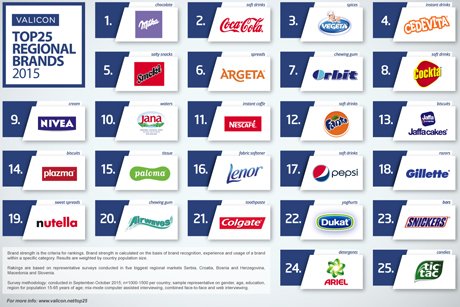
Valicon, one of the leading market consulting and research agencies in the Southeast European region, with a special focus on the countries of the former Yugoslavia, has once again measured the strength of brands in the region encompassing Croatia, Slovenia, Bosnia and Herzegovina, Serbia, and Macedonia. Valicon has been tracking brand strength in this way for the 13th consecutive year.
The top three brands are Milka, Coca Cola, and Vegeta. They are followed by brands from the Atlantic Group – Cedevita, Smoki, and Argeta, then Orbit, Cockta, and Nivea. Two of the most interesting news items are: the continued growth of Serbian brands, specifically Smoki and Plazma, a trend first noticed in 2013, and the resurgence of Jana, which has entered the top 10.
From the list, a certain “rule” can be recognized by which some brands can find their place on the Valicon TOP25 regional brand list. These are brands present in the five largest markets of the region. In this way, it is difficult to find any local brands on the list of the strongest, in those categories where it is significant that they are dominated by national brands, such as the categories of beer, coffee, mineral water, dairy products, ice cream… Furthermore, it is difficult to find brands that are in categories that do not have a large spread, such as cigarettes, strictly female and male products, or brands from the premium segment. The reasons for “movement” on the list can also be sought in the growth or decline of the category. Some categories have less, while others have more pronounced leaders.
Active presence in the largest Serbian market is a prerequisite for entering the Valicon TOP25 regional list. Due to the size of the national market, Serbian brands have a slight advantage over others. The advantage is even twofold – on one hand, the influence of market size, and on the other hand, the still non-existence of discount retailers and the poor development of private labels to the extent seen in the markets of Croatia and Slovenia.
There are six main factors that influence the positioning of individual brands:
1. One is the market we observe from the perspective of trade development, private labels, and the development of the category itself. Changes in the domestic market and in Serbia as the largest market have the greatest impact on strength.
2. The activities of competitors should also be taken into account.
3. In addition to all this, it is important to monitor trends that affect penetration and frequency of consumption of categories and subcategories. For example, health trends, savings trends, trends of (not) going out, trends of value importance…
4. Of course, there are also the own activities of the manufacturer, or the brand we are observing.
5. There is also the decision related to the brand portfolio. In the process of category consolidation, manufacturers have many brands of varying strengths by country. A strategic decision to develop one strong regional brand is a condition for appearing on this list.
6. Recently, the relationship towards so-called b-brands has become very important. These are less strategic brands that, due to lower purchasing power, their owners have positioned at a lower price, but still with investments in their marketing and sales. There are more and more such examples: the first were brewers – Löwenbräu and Holsten in the region, C coffee and Bonito in Serbia, Rex in detergents… When a company decides on a portfolio that includes b-brands, it always negatively affects the strength of the main brand. Cannibalization always occurs.


