
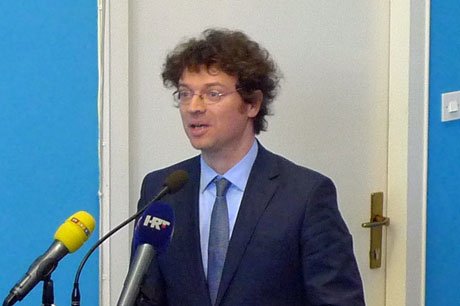
The amount of scandal that has befallen the newly formed government is so extraordinary, and at the same time journalistically stimulating, that it is hard to compare it to the start of any other government since the young Croatian state came into existence. However, while you could read (and, in fact, still can) about Crnjac and Hasanbegović in hundreds and hundreds of printed pages of journalistic texts, the views of the current Minister of Education and Science have only recently begun to be written about, still discreetly, in the last few days.
As reported by the media, Minister Predrag Šustar stated in an article from 2012 that ‘the question of evolution is still open’ and that ‘the theory of evolution has not provided definitive solutions.’ Such a stance, which has also been abandoned by the official Catholic Church, is more appropriate for some past centuries, but is also extremely concerning when expressed by a person holding the position of the head of such an important sector. To be fair, Šustar’s public appearances are quite polished and far more refined than some other politicians who have recently come into the spotlight, but this background once again shows how Croatia has yet to find a suitable person at the helm of probably the most important ministry.
I say the most important, although no government has perceived it as such so far, since it primarily holds the foundation for the social and economic transformation that we talk about so much. However, the selection of more or less inappropriate and/or incompetent individuals for this function has been going on for too long, and it is quite clear that regardless of the political option, education has yet to come to the center of political interest.
Of course, there is still a theoretical possibility that Šustar may prove to be better in his political actions than in his scientific ones. His first move showed that, if nothing else, he nurtures a conciliatory style as well as a certain inclination towards compromise, which is a virtue to be appreciated in the current increasingly aggressive rhetoric in society. Šustar, namely, after initial announcements that the new government would reject all the work done by the previously formed working group for curricular reform, quickly denied such claims and stated that their work would be respected. Moreover, this week the new minister held his first press conference where he supported the proposed education reform.
The reform foresees, as can be read, changes such as the absence of grading in the first two grades of primary school, flexible scheduling, the introduction of modules instead of professions in secondary schools, as well as learning through work in vocational schools. Somewhat discreetly, but still, contents related to information and communication technologies, health, and entrepreneurship are also being introduced, although without the introduction of special subjects.


