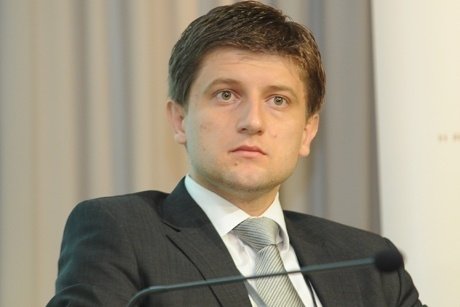
Finance Minister Zdravko Marić assessed on Thursday the European Commission’s projections for the growth of the Croatian economy this year at 2.1 percent as a “good starting point,” but emphasized that the Government will do everything it can to accelerate that economic growth.
The European Commission raised its estimate of the growth of the Croatian economy this year to 2.1 percent, from the previous 1.4 percent. In a statement to the media after the Government session, Marić particularly highlighted the fact that the EC has corrected its previous expectations from three months ago.
– If you compare it to all other EU countries, this is practically the largest upward correction. Only a few countries have had their growth corrected upwards. Of course, certain risks for the entire EU economy were also taken into account, primarily for the largest economies, so the correction for Germany, Italy, and France was made downwards, said Marić.
The Government views this correction positively, as a good starting point, he stated.
– However, this is not a growth rate that we can be satisfied with not only during our mandate but generally in the medium term, and this Government will do everything it can to accelerate that economic growth, emphasized Marić.
He also stated that the measures he will soon present will primarily be aimed at strengthening domestic aggregate demand, specifically on investment activity, which they believe should be one of the main, if not the main driver and engine of growth in the upcoming period. When asked how much the correction of forecasts is a result of faith in this Government and how much is a result of the work of the previous Government, the finance minister replied that it is difficult to quantify, but “the new Government, its announcements and program certainly had a significant impact on that correction.”
Dialogue with the EC will continue; they will question what measures are in place and how Croatia can accelerate economic growth and correct the imbalances it faces, said Marić, announcing that he will personally have the first dialogue with them at the beginning of next week, and that at the end of next week he will travel to his first meeting of EU finance ministers. When asked how close the EC’s forecast of a budget deficit this year of 3.9 percent of GDP is to the Government’s intentions, the finance minister emphasized that the Government’s intention is for that level to be as close to 3 percent as possible.
– We are targeting a level of 3 percent of GDP already for this year. The EC’s projection of 3.9 percent of GDP was made under the so-called “no policy change” assumption, meaning without any changes in policies, without any measures. We are here to make those changes and to implement those measures, which will further reduce the budget deficit for this year towards levels of 3 percent. That is our intention and our idea on how to stabilize public debt this year, because if you look at the EC’s projections, with a 3.9 percent deficit, it would practically mean that this year public debt continues to grow at a somewhat slower pace than in previous years, however, our intention is to stop that trend this year and to move towards reduction during the remainder of the mandate. Our goal is to reduce public debt to a level of 80 percent of GDP in the next three to four years, from the current nearly 90 percent,” emphasized Marić.
As the budget for 2016 has not yet been adopted, under unchanged assumptions, the EC estimated that the general government deficit in 2016 will amount to 3.9 percent of GDP, after last year’s 4.2 percent. In 2017, a deficit of 3.2 percent of GDP is expected. These deficit estimates are lower compared to the autumn forecasts when the Commission expected that in 2015 the deficit would amount to 5.6 percent, this year 4.7, and in 2017 4.1 percent of GDP.
The EC also estimates that the debt increased moderately in 2015, from 85.1 percent of GDP in 2014 to 86 percent in 2015, which is a result of stronger GDP growth. The EC estimates that the share of public debt in GDP will continue to grow in the next two years. Thus, this year it could reach 87, and next year 87.4 percent of GDP. These estimates of public debt growth are lower compared to the autumn forecasts when the Commission expected that by the end of 2017 public debt would reach 92.9 percent of GDP.