
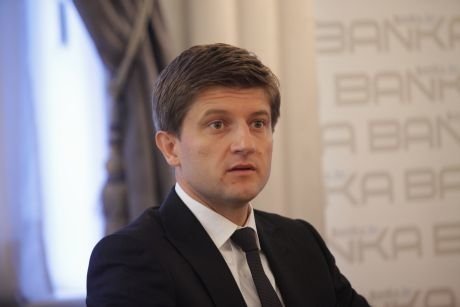
Prime Minister Tihomir Orešković, Finance Minister Zdravko Marić, and the Governor of the Croatian National Bank (HNB) Boris Vujčić met on Wednesday with representatives of the International Monetary Fund (IMF) Mission, the new head of the IMF Mission for Croatia Khaled Sakr, and former head of the Mission Johannes Wiegand to present the Government’s plans regarding the budget.
Ahead of the joint meeting, Khaled Sakr stated that he came to familiarize himself with the plans of the new Croatian Government. “I am here to hear from the Prime Minister, the Finance Minister, and the Governor of the central bank about their economic visions,” said Sakr, adding that reforms are very important for Croatia, which has enormous potential. He also expressed hope that reforms will be implemented to achieve the goals outlined in the government program.
When asked what specific measures he expects from the Government, he reiterated that he intends to listen to the Prime Minister, the Finance Minister, and the Governor today. He added that there are “many imbalances” in Croatia, for example, unemployment is high, while there is significant potential for continued export growth. It is important to ensure a good start to secure sustainable progress based on increasing employment and exports, says Sakr.
When asked whether the IMF recommends any cuts and savings, he announced that the next meeting will be in a few weeks, where there will be more technical details and discussions, and that he came today to listen, which he considers “very important.”
Marić: We presented the Government’s plans with the budget
Finance Minister Zdravko Marić stated on Wednesday ahead of the meeting with IMF representatives that the appointment of the new Government coincided with a change at the head of the IMF mission for Croatia and that its new leader Khaled Sakr came to introduce himself and get acquainted.
He also emphasized that earlier today at the HNB, he and Governor Boris Vujčić discussed with IMF representatives topics from the sphere of monetary policy, but with, as he said, a greater emphasis on the sphere of fiscal policy. “Of course, the gentlemen from the IMF were interested in hearing a bit more about the plans and ideas regarding economic policy and the budget. We presented to them what we presented a few days ago in the Parliament, namely what the Government’s intentions are, what we plan, and what we want to do with this year’s budget and what our visions are for the next four years,” said Marić.
When asked whether there will be cuts and whether they requested them, he said that they did not discuss it in that way. “No, we did not discuss it in that way, we did not go into details. As I said, it was an introductory meeting. In the next three weeks, or four weeks, in the middle of the second month, Mr. Khaled Sakr will return with his team, and it will be a visit for the whole week, where we will, among other things, discuss the details of the budget itself,” said Marić.
When asked what he expects from the afternoon meeting with the Franak Association and what he will propose as a solution to the problem, considering that from today the exchange rate of the franc for borrowers in CHF loans is not fixed against the kuna, Marić said that he wants to hear the Franak Association and their views today.
“For me, the main and first thing for today’s meeting is to hear the Franak Association, their views, since I have never met with them before. I have followed everything through the media, so I expect to hear them and see how, what, and how we will define it,” he said.
When asked by journalists what could be generally offered as a solution to their problem, he said he would not comment on anything at this time. “Let’s wait for the meeting to see what they will have to say,” said Marić.
Responding to a question about the Crnoja case, Marić said he was aware of it through the media and emphasized that the Tax Administration will do its job and that he cannot and will not comment on anything that falls within the realm of tax secrecy.


