
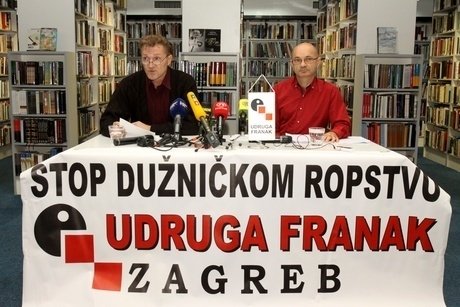
The Franak Association reported on Tuesday that it has requested an urgent meeting with the Government regarding the pre-election promises of HDZ and MOST, while the Kreda Association warned Prime Minister Tihomir Orešković in an open letter that he is only informed about the issue of CHF loan conversion by the governor and banks, not by the debtors themselves.
In a letter addressed to Prime Minister Tihomir Orešković and the ministers of finance and justice, the Franak Association reminds of the pre-election promises of MOST and HDZ that once they come to power, they will organize a working group that will include representatives of that association, which would prepare a law within three months to regulate fixed margins in all loans with variable interest rates where a fixed margin is not contracted, in such a way that they are determined as the difference between the initially contracted interest and the initial value of the variable parameter.
MOST also promised to pass a law for the return of overpaid interest amounts based on a final judgment in a collective court process, the Franak Association reminds.
“The Franak Association expects an urgent meeting with the Government, as well as the fulfillment of public promises,” they stated.
They also emphasize that on January 18, they reported to the Commission for the Decision on Conflict of Interest the governor of the Croatian National Bank (HNB) Boris Vujčić. Vujčić, as stated by the Franak Association, from January 13 to 15, as the governor of HNB, the supervisory body of all banks in Croatia, was a participant in a private conference of the business entity UniCredit Bank, the owner of Zagrebačka Bank.
According to available documentation from the application annex, the reported governor actively participated and spoke at the conference, and also participated in the informal part of the program, panels, socializing, dinners, etc., all at the expense of the organizer UniCredit Bank, the owner of Zagrebačka Bank.
“The question arises as to what impartiality and independence the governor of HNB can have when he goes and participates in a private conference of a business bank that he should be supervising in its operations,” the Franak Association emphasizes. They add that the Association has detailed arguments for the conflict of interest report requesting “urgent action and the strictest prescribed sanctions for the governor.”
The Kreda Association Wants the Prime Minister to Hear the Debtors
The Kreda Association of credit debtors on Tuesday warned Prime Minister Tihomir Orešković in an open letter that he is only informed about the problem of the Swiss franc by the governor and banks, but not by the debtors themselves who have been fighting for over four years against what they describe as illegal plunder.
The Kreda Association emphasizes that on January 25, the Prime Minister told citizens in an interview with RTL television: “Don’t worry, we have fixed that exchange rate and we will leave it there. I need to meet with my ministers and the governor of HNB to ultimately make the best decision.” Therefore, they remind the Prime Minister of a series of contentious points for debtors in Swiss francs – that debtors with kuna loans nominated in CHF have been struggling with the system for four years seeking a solution to problems with the currency clause, with an undefined interest rate and debtor servitude, but also how they have achieved a Supreme Court ruling through civic engagement according to which banks acted illegally towards credit debtors in all currencies through unilateral changes to contracted conditions.
They also state that based on that ruling, citizens can only file expensive and lengthy private lawsuits with uncertain outcomes because, it is emphasized, domestic justice is slow and unpredictable. Thus, they stress from that association, that historic ruling becomes useless for most financially exhausted debtors, even though it represents legal proof of illegal banking operations in Croatia.
They remind again that through illegal interest rate increases along with the simultaneous rise of the Swiss franc exchange rate, 12 billion kuna has been taken out of Croatia. On the other hand, if that money had remained in Croatia, the GDP decline would have been approximately 3 percent smaller and there would have been thousands more employed, it is stated in the open letter from the Kreda Association.
They emphasize that HNB has not done its job, because if it had regulated financial operations, unfair contracts would never have been concluded. Instead of being a regulator of the financial market, the Croatian National Bank, through its inaction, has given complete freedom to the arbitrary behavior of business banks in Croatia, they state in that association.
“In trying to simultaneously suppress the anger of deceived and impoverished citizens, satisfy enormous banking appetites, and comply with the directives of the European Commission, with the ultimate goal of further borrowing by the state from business banks in Croatia and collecting political points with citizens, the Croatian Government is adopting a series of improvised measures that temporarily and partially solve the problem, ultimately completely ignoring the Supreme Court ruling. Interest rates on loans in Croatia are still among the highest in the European Union, which significantly narrows the space for borrowing by the economy and citizens, and due to excessively high interest rates, we are witnessing massive deleveraging of both the economy and citizens, which causes banks to experience a liquidity surplus of approximately 10 billion kuna,” states the letter from the Kreda Association.


