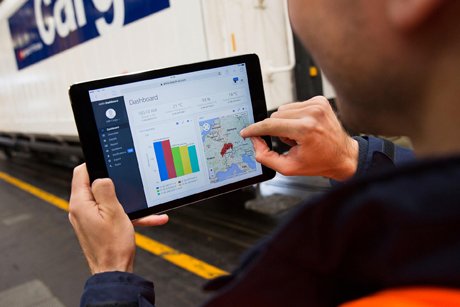
Thanks to Bosch, the next stop for freight trains is the internet. The “Internet of Things,” which connects real and digital information, is revolutionizing rail freight transport with the help of new digital technology for vehicles.
More than 300 freight cars have already been equipped with the new Bosch system and are being used to test this technology in rail transport across Europe, North America, and Australia. Production of the system is scheduled to begin in mid-2016.
– We use intelligent connected sensors to capture data about freight cars in real-time and process it online. This means that the cars can determine themselves whether the cold chain has been maintained, predict delivery arrival times, and provide information on when the next maintenance is due, says Bernhard Bihr, president of Bosch Engineering.
Connected Technology for Efficient Logistics
To withstand harsh working conditions such as temperature changes, vibrations, dirt, and humidity, railway engineering must be simple and robust. In 2013, nearly 400 million tons of goods were transported on approximately 40,000 kilometers of railway track in Germany alone. One reason why connectivity technology, which is advancing rapidly in almost all other sectors worldwide, has not penetrated the rail freight transport sector is that freight cars lack their own power supply and sensors. Bosch Engineering is now bridging that gap with a connected vehicle notification system for rail freight transport. This system uses proven and tested technology from the company as well as components used in the mass production of cars.
– Our automotive technology can also be applied in other sectors, including rail transport. This new system allows us to make logistics chains in rail, road, and maritime transport transparent and to manage the increase in freight transport more efficiently, says Bihr.
Precise Location Determination
The ability to continuously monitor deliveries and receive information about whether they arrive at their destination on time is standard for road transport deliveries. However, when it comes to rail transport, this is more often the exception than the rule, as freight cars have not been able to provide the necessary information until now. Timing is crucial, especially in cases where we rely on a combination of rail, road, and maritime transport, to ensure the efficiency of logistics processes. With the new vehicle notification system, the connectivity hardware installed in freight cars currently provides the necessary information, enabling the location of each car to be determined. As a result, it is possible to track and monitor deliveries by rail from origin to destination, ultimately saving money, improving logistics planning, and helping to ensure more reliable scheduling and more accurate delivery times.