
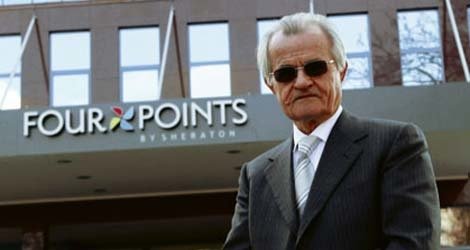
Apart from the tourism industry, the company HUP Zagreb is not as well-known as its leading figure Anđelko Leko, who has been building his business empire in Zagreb for 45 years, becoming an indispensable figure in the hotel business.
writes Željka Laslavić
[email protected]
From a small city catering company with a few hospitality facilities, Leko has transformed HUP Zagreb into hotels with the first foreign well-known brands in Croatia, signed the first management contract in the hotel industry with the international chain Starwood, which includes Westin, Sheraton, and Four Points Panorama. HUP Zagreb is celebrating its 60th anniversary this year and employs 875 employees through its subsidiaries, of which 28 are in management. Peak at HUP Many domestic and foreign entrepreneurs have had and still have a ‘peak’ at HUP Zagreb, of which Leko is the majority owner; there have been serious offers to purchase hotels and shares in the company on several occasions, but Leko has reportedly inflated the price by up to 70% higher than its estimated value, causing investors to withdraw. Leko most likely does not have serious ambitions for sale because, although he is 76 years old, as he himself says, he does not know what to do with further plans and investments if he sells HUP Zagreb. The leading figure in hospitality (he also chairs the Croatian Hotel Association) has only one other member in the Management Board, his son Ivan Leko, who graduated in Tourism from the Faculty of Economics, underwent professional training at the Imperial Hotel in Vienna, and then got a job in his father’s company. Although he has gone through all the necessary business processes to become a successful manager, some hoteliers believe he would not be able to keep up with his father’s pace, and Anđelko Leko claims he has not yet discussed with his son the possibility of him inheriting his position. The third key person at HUP is Leko’s deputy Branimir Protrka.
A healthy company
The hotel industry agrees that HUP Zagreb is a healthy company, but according to some experts, it lacks good individual managers who could make decisions more freely. Although he is one of the first pioneers of modern hospitality in Croatia, Leko leads HUP Zagreb in a traditional, centralized manner, which does not mean that it has resulted in negative outcomes. With its six subsidiaries, it has been achieving fairly balanced revenues of around 350 million kuna for years, mostly from hotel operations. Recently, HUP Zagreb has been quite active in buying back its own shares, and it is questionable whether they are intended for rewarding management or all shareholders.
Given the low profitability of the hotel industry, Leko is diversifying his activities and revenues of the subsidiaries engaged in real estate, catering, and gambling, which generate significant income with minimal costs. Although he planned to renovate the dilapidated Hotel Zagreb at Bundek into a more acceptable facility, Leko decided to demolish the building and construct commercial and residential spaces, thereby directly entering a new real estate business: – Although we initially announced that we would renovate Hotel Zagreb, we abandoned that idea: we will demolish that facility, purchase an additional 30,000 square meters of construction land at that location, and independently or in collaboration with strategic partners build residential and commercial spaces – explains Leko.
Future investments
Five key projects of HUP Zagreb
Bundek
• construction of a mixed-use building on an area of approximately 35,000 square meters
Srebreno
• a new four-star hotel with a capacity of 270 rooms with all additional amenities and renovation of six villas with 60 luxury rooms
Mlini
• additional investments in Hotel Astarea to a four-star level, adaptation and extension of Hotel Mlini to 120 rooms
Westin
• construction of a wellness center for one million euros in collaboration with World Class, a company investing in equipment, renovation of the hotel lobby and catering facilities located on the ground floor worth 2.5 million euros
Sheraton
• renovation of rooms to maintain market position in the segment of five-star categorized hotels
HUP Zagreb is reportedly financially capable of covering the announced investments, although the company is quite burdened with loans. According to the analysis of financial indicators, HUP had slightly more than half a billion kuna in long-term obligations and about 200 million kuna in short-term obligations last year. This is approximately the amount of total investments made by the company in the past six years.
‘Old school’ entrepreneur
What always seems confusing is the ownership structure, or shares in individual facilities and projects of HUP Zagreb. The majority owner of HUP is Expertus, with a 51% ownership stake, whose majority owner is Anđelko Leko. However, the most complex ownership relationship is over the Sheraton hotel, whose majority owner is HUP’s subsidiary H.B.I, which shares ownership with the State Agency for the Rehabilitation of Banks and Savings Deposits, which owns 49% of the shares.



