
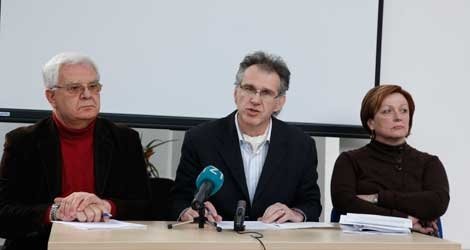
The Croatian Veterinary Society will ceremoniously mark 115 years of operation on Friday, as announced at today’s press conference in Zagreb. The ceremony, under the high patronage of the President of the Republic Stjepan Mesić, will be held at the Old Town Hall in Zagreb.
The President of the Management Board of HVD, Albert Marinculić, took the opportunity of this announcement conference to reflect on the Society’s achievements so far. He emphasized that HVD is one of the oldest veterinary societies in the world, which has significantly contributed to environmental preservation and health, not only of animals but also of humans by controlling food of animal origin.
The Vice President of the Society’s Management Board and Vice President of the Federation of Veterinarians of Europe, Ljiljana Markuš Cizelj, stated that the Federation brings together 43 veterinary organizations from 37 countries where 200 thousand veterinarians work. In this regard, she noted that due to such a large number of organizations and veterinarians, the motto ‘one profession, one voice, one vision’ has been promoted to protect the interests and promote the profession of the Federation’s members.
Among this year’s activities, HVD will organize a large international scientific-professional congress and the ECO WORLD FEST exhibition from April 2 to 4 in Opatija. During the year, there will also be a gathering on the occasion of World Rabies Day, and in October, a professional meeting on animal welfare as well as the Third Symposium on Exotic and Wild Animals. The Executive Director of HVD, Josip Janeš, also spoke about the reputation of Croatian veterinary medicine, stating that the models for combating avian influenza and trichinosis have now become global models. However, he also expressed regret that in Croatia, when voting on legal and other normative acts, the voice of the profession is often not heard, and regulations are adopted ad hoc. In addition, he warned about the problem of veterinarians in public administration who have come to their positions without having previously spent some time in the field, which was once unthinkable.



