
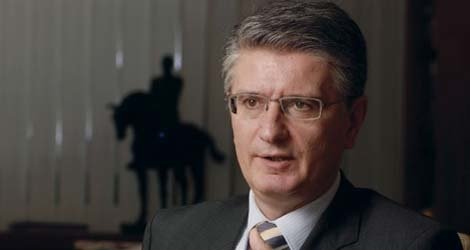
According to the worst-case scenario, we will have to lay off a larger number of workers. So far, we have implemented ‘soft’ measures, such as a 10% salary reduction and shortening the workweek to 36 hours
interviewed by Matilda Bačelić
[email protected]
Gorenje is not the largest Slovenian company, although its total revenue of 1.3 billion euros places it at the top, but it is probably the largest multinational from the former state. It has 50 companies abroad where it generates 90 percent of its sales, and in recent years it has been trying with all its might to transform itself from an industrial company into a design giant. The current crisis has caught it in such a position and hit it mercilessly. Sales have sharply declined in almost all markets, prompting Gorenje to seek state aid and announce layoffs, while currently using an ‘innovative’ method of persuading employees that it is better to leave voluntarily. With the arrival of tough times, more and more critics of Gorenje’s management, led by Franjo Bobinec, are criticizing some moves, such as dealing with ownership issues. The Chairman of the Supervisory Board, Jože Zagožen, states that it would be hard to find a better person to lead Gorenje. According to the current estimates of the management, Gorenje can survive another 12 to 18 months if the crisis does not significantly worsen, as the level of indebtedness and illiquidity are not yet alarming. The first ‘man’ of Gorenje in an interview with Lider speaks about the situation in the Croatian market in light of deteriorating political relations, about facing the crisis and the current strategy, without disclosing specific figures considering that official results for 2008 are expected on February 26.
• How does the current Slovenian-Croatian political crisis affect Gorenje’s business?
– There are no analyses on how much sales are falling due to such a situation. Political tensions between the countries, there is no doubt, are not good for economic relations. I often meet with Slovenian politicians, not only as the President of Gorenje’s Management but also as the President of the Association of Managers of Slovenia, and I always say that the relationship between Slovenia and Croatia is not only a political but also a first-class economic issue and that good neighborly relations should be maintained. Croatia is one of Slovenia’s most important foreign trade partners and vice versa. Politics on both sides often lacks sufficient understanding of these matters, but we have become accustomed to this in these areas. I personally greatly appreciate Croatia as a country with great potential, and it is a shame that such things happen.
• Do you think that in the end, economic interest will prevail, or is this still an important political issue for Slovenia? Does the Slovenian government listen to entrepreneurs?
– I believe that the government is aware that it is in our interest for Croatia to enter the EU and for the border to expand further southeast. However, politics is always the art of the possible, and in some situations, other factors decide. I personally believe that things will be resolved very quickly. The Slovenian government is now engaged in ratifying Croatia’s entry into NATO, and it is only a matter of time before Croatia enters the EU. I think that in the end, Slovenia will be a strong advocate for Croatia’s entry into the EU because it is also in its interest.
• How important is the Croatian market to Gorenje?
– About five percent of Gorenje’s total turnover comes from Croatia, which is a significant share considering that our turnover structure is very dispersed. Croatia is among our top ten markets. At this moment, we have liquidity problems and political disagreements, although I believe that the crisis has a much stronger impact on the decline in sales.
In Croatia, the liquidity crisis
has been bad for the last two months of 2008
• As far as is known, your sales are dangerously declining. How are things now?
– We generally have problems with orders for the first quarter of this year. The last two months of 2008 were bad in many markets, including Croatia. I believe that there is a liquidity crisis in Croatia, and our products are not food that is bought every day. We sell durable consumer goods, and in a crisis, consumers think twice about purchasing them, especially if they are buying on credit. On the other hand, the structure of trading companies is also transforming, and new distribution channels are being created.
• Have you revised your plans for 2009? What are the current forecasts?
– Under these conditions, accurate forecasts cannot be given. We have agreed to review results every three months and see what needs to be done. We have just completed a sales conference with all branches of the sales network worldwide and will make a plan for the second quarter.
• What is your ‘black scenario’ in case the crisis becomes even more serious?
– We have already developed three scenarios for the crisis. Each scenario has its action plan depending on the severity of the decline in demand. According to the worst-case scenario, we will have to lay off a larger number of workers. So far, we have applied ‘soft’ measures such as a 10% salary reduction and shortening the workweek to 36 hours.
• Are EU markets still a priority for you, or has the focus shifted to the East?
– Russia and Ukraine are very important markets for us, but we are also seeing a significant decline there. Ukraine has fallen the most, almost 80 percent. The problem is that the local currencies, the hryvnia and the ruble, have strongly devalued, which greatly affects the demand in these two countries. At this moment, we have even bigger problems in the East than in Western Europe.
• And you have focused on those markets in recent years…
– We have never oriented ourselves solely to the East. Our strategy outlines that all of Europe is our domestic market, but in recent years, the East has grown at much higher rates. Today, our market shares are larger in the East than in the West. In Eastern Europe, Gorenje is one of the leading brands with a market share that varies in different segments between four and 30 percent, while in Southeast Europe, we hold shares of 50 percent and more.



