
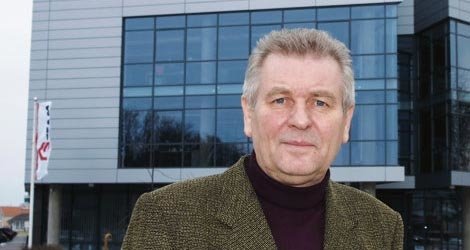
For a medium-sized construction company, taking on a large job is very risky. If such a project stalls, the company can go bankrupt. Therefore, the CEO of Team, Josip Švenda, prefers projects of smaller individual value.
writes Mislav Nekić
[email protected]
Last Thursday, the first tranche of commercial papers from Team, based in Čakovec, worth 40 million kuna, was withdrawn from the regular market of the Zagreb Stock Exchange, meaning it has come due. Part of the refinancing money was secured from operational business at Team, while the remainder was financed through a loan from the parent Raiffeisen Bank. The question arises: How will this affect the current operations of the Međimurje construction giant, which is in a restructuring phase, while also navigating the global financial crisis that has not spared the Croatian market? Josip Švenda, the CEO of Team, says that the crisis is felt, but he considers it a welcome and great opportunity for his company because it will show who is strong during tough times and predicts the collapse of numerous companies engaged in ‘trading construction’, as he refers to builders who have entered the market overnight, starting to build wherever they could, regardless of quality, just to sell. In addition to bringing long-standing players (Team, Međimurje graditeljstvo, Tehnika Kamgrad, Koteks, Zagorje – Tehnobeton) into disrepute and taking away some of their highly qualified workers, from foremen to project managers.
Reliance on Ingra and IGH The lack of workforce at Team has been attempted to be compensated by acquiring smaller companies from the Međimurje area. Through acquisitions, they aimed to concentrate expertise and prepare for entering foreign markets. Although they have gone far in negotiations, they opted for a longer-term variant of gradually training their own employees, of whom there are currently 350 in the company. For this reason, Alen Kišić, who has proven himself in companies such as Podravka and Metro Cash & Carry, was brought in as the assistant to the CEO for Human Resources and Public Relations. They collaborate with the Faculty of Civil Engineering in Zagreb and the Construction School in Čakovec, offering scholarships to its students. He says that the company he leads sees an opportunity in restructuring, which would allow them to become market leaders with several quality companies.
Contracted jobs
In the first half of the year, work worth 100 million kuna
Despite the difficult situation in construction caused by the global crisis, Team has secured several large projects worth around 100 million kuna in the first six months of 2009. These include the construction of a new modern building of 1,500 square meters for the Social Welfare Center in Čakovec, the reconstruction of the gynecology building at the General Hospital in Sisak, and the start of the reconstruction of the Park dependency on the Red Island near Rovinj. Additionally, about ten days ago, Team began preparatory work on the project for building a school sports hall in Kastav.
– Alongside new projects, work is ongoing on projects that began last year, including the completion of the Library of the Faculty of Philosophy in Zagreb, the reconstruction of the Vespera Hotel in Mali Lošinj, the construction of a sports hall in Sveti Martin, the construction of a sales-service center for MAN in Hrvatski Leskovac, and the adaptation of the pavilion of the Public Health Institute in Čakovec. We will soon start work on the project for building our own business-residential building for the market in Umag, and we are about to sign contracts for several other projects,” Švenda told us.
– Unlike the current situation, where we are not building anything abroad because we do not have enough quality people, once the market stabilizes, we see an opportunity in entering foreign markets. At this moment, we can only be abroad with someone who will be the project leader,” says Švenda. When asked who that someone is, he replies that it is now Ingra and the Institute of Construction of Croatia. The main activity of the company is high-rise construction. Although they do not yet have a revised report, Team expects revenue of 235 million kuna, which is approximately the same as the revenue in 2005 (223 million kuna). Thanks to the work on the reconstruction project of the Istra Hotel on the Red Island for Maistra as the investor, the company achieved a record revenue of 297 million kuna in 2006. However, the scale of the project, which utilized more than 50 percent of the company’s capacity, led to a sharp decline in revenue in 2007, which amounted to 207.5 million kuna.



