
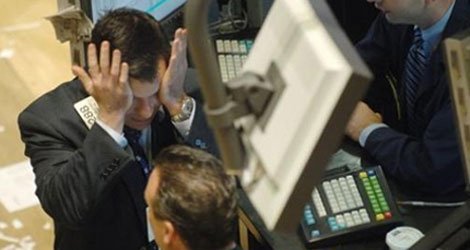
Last week, stock prices on global markets fell sharply as investors feared new bank losses and a deterioration in business conditions, as indicated by warnings from numerous companies.
In the past week, the Dow Jones index on Wall Street plummeted by 5.6 percent to 8,281 points. The S&P 500 index fell by 5.9 percent to 850 points, while the Nasdaq index lost 3.02 percent, diving to 1,529 points. The banking sector was in focus for investors last week, particularly Citigroup, following news that this once-largest bank in the world, now the third largest in the U.S., is selling its brokerage division to Morgan Stanley. Citigroup reported a loss of $8.29 billion in the last quarter, necessitating cash to improve its balance sheet. Additionally, to pull itself out of the crisis, Citigroup announced a split into two companies.
The fact that the U.S. financial system has not yet fully recovered is also shown by the data that Bank of America, the largest American bank, reported a loss of $1.79 billion in the last quarter of last year, marking its first loss in 17 years, excluding the loss from Merrill Lynch. To complete the acquisition of Merrill Lynch, U.S. authorities approved $20 billion in fresh capital and guarantees for losses on bad debts acquired with the purchase of Merrill Lynch. Despite government assistance to banks, investors are concerned about the financial sector. The situation in the credit market has not yet fully normalized, and the recession has affected the largest global economies, raising the fundamental question of whether banks will need fresh capital and where they will find it, analysts say. “There is great uncertainty in the market regarding how deep the recession will be and whether a second round of write-offs of uncollectible bank debts will follow,” says Lincoln Anderson, director of LPL Financial. The European banking sector is also suffering from the further consequences of the credit crisis.
Last week, Deutsche Bank reported a loss of over $6 billion in the last quarter of last year, while British HSBC, the largest bank in Europe, will have to drastically cut its dividend and seek $30 billion in fresh capital to cover the ‘gap’ in its balance sheets. Investors were also alarmed by new poor macroeconomic data indicating a deepening recession in the largest global economies. For instance, in the U.S. in December, a key consumer month due to the holidays, retail sales fell by 2.7 percent, which is double what analysts expected. This triggered a drop in the stock prices of retail chains, causing the S&P index for that sector to plummet by 3.6 percent in just one day. Investors are also cautious because the earnings season for companies has started poorly. The largest American aluminum producer, Alcoa, reported a larger quarterly loss than expected and announced layoffs. “Profits drive the capital market, so it is clear that we want to see if anyone has any profit. However, companies are only sending warnings about declining profits, so we can expect a flood of warnings about deteriorating business conditions.



