
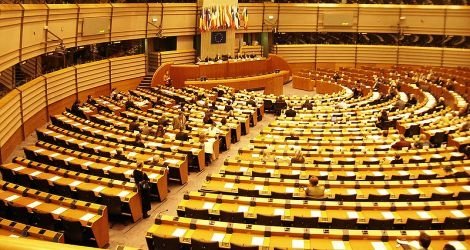
Members of the European Parliament have submitted 65 amendments to the resolution proposal on Croatia’s progress by rapporteur Hannes Swoboda, emphasizing that the completion of negotiations must be a common goal for all parties and that open bilateral issues must not be an obstacle to accession to the European Union.
The rapporteur for Croatia, Hannes Swoboda, presented his resolution proposal to the Foreign Affairs Committee of the European Parliament on December 2, when it was agreed that the deadline for submitting amendments would be December 16.
The Foreign Affairs Committee of the European Parliament will discuss the draft resolution and the submitted amendments at the end of January next year, and the resolution is expected to be adopted in March at the plenary session of the European Parliament. In the draft of Swoboda’s report, Croatia is “commended for the good results it achieved during 2008 in adopting legislation and implementing reforms necessary for EU membership.” Several amendments have been submitted to the part of Swoboda’s text stating that the completion of “technical negotiations with Croatia in 2009 must remain a common goal for all parties involved in the negotiations” and that this goal is achievable, with most calling for this provision to be formulated even more strongly in the text.
Latvian MEP Inese Vaidere, from the Union for Europe of Nations (UEN) political group, emphasizes in her amendment that “the goal of completing accession negotiations in 2009 is very realistic in accordance with the indicative timetable recently published by the European Commission.”
In several amendments the Council and the Commission are called upon to take into account the current economic and financial crisis when assessing Croatia’s progress in implementing reforms in shipbuilding and the privatization of shipyards.
Only the amendments of Milan Horacek, a German MEP of Czech descent from the Greens party, and Geoffrey Van Orden, a British Conservative MEP from the European People’s Party, seek to soften these formulations. Thus, Horacek proposes an amendment stating that “the completion of technical negotiations should remain a common goal,” instead of “must,” as stated in Swoboda’s proposal. Van Orden suggests replacing the year 2009 with “as soon as possible.” In several amendments, the Council and the Commission are called upon to take into account the current economic and financial crisis when assessing Croatia’s progress in implementing reforms in shipbuilding and the privatization of shipyards.
Hungarian MEP Istvan Szent-Ivanyi from the liberal political group submitted an amendment expressing “deep regret that the accession negotiations have been blocked for a significant time due to a bilateral problem that should not be an obstacle to EU accession.”
This time, numerous amendments from Slovenian MEPs were absent, who regularly proposed that only Croatia be called upon to resolve open bilateral issues, not its neighbors.
This time, unlike previous years, numerous amendments from Slovenian MEPs were absent, who regularly proposed that only Croatia be called upon to resolve open bilateral issues, not its neighbors. Aurelio Juri, who succeeded the current Slovenian Prime Minister Borut Pahor in the European Parliament, proposed an amendment stating that “bilateral issues should not be an obstacle to accession” and calling on “the Croatian government and the governments of neighboring countries to resolve their open issues as soon as possible.” This amendment is almost identical to Swoboda’s proposal. Aurelio Juri is the only member of Pahor’s Social Democrats who has expressed reservations about Slovenia’s blockade of Croatian negotiations, while his brother Franco Juri, a member of the Zares party, was the only one in the Slovenian parliament against the blockade.
Swoboda proposed an amendment to his text!
Swoboda proposed an amendment to his text requesting that the Croatian government “accelerate its efforts to ensure that the missing military documents in the Gotovina case before the ICTY are immediately made available to the Court.”
The draft resolution and some amendments welcome the initiative of the Croatian Minister of Justice to temporarily freeze the assets of individuals accused of organized crime and corruption. The draft resolution “expresses satisfaction with the freedom of the press in Croatia, but draws attention to recent cases of intimidation, including the murders of journalists investigating cases of corruption and organized crime.” It also welcomes the adoption of a comprehensive anti-discrimination law, and authorities at both national and local levels are called upon to show “zero tolerance for incidents of racial hatred and any other forms of hatred and to ensure that such incidents are appropriately prosecuted.”
This time, amendments from certain Italian MEPs were also absent, who each time requested that “recognition of the massacre of more than 20,000 Italians committed by the communist authorities of former Yugoslavia” be included as a prerequisite for Croatia’s accession to the European Union. Such amendments have never received support in the European Parliament.
Resolutions of the European Parliament are legally non-binding, and the Parliament itself has no influence on accession negotiations.
Resolutions of the European Parliament are legally non-binding, and the Parliament itself has no influence on accession negotiations. The only role of the European Parliament in enlargement policy is to approve the accession treaty, as the Parliament co-decides on the common European budget, which has implications for enlargement. (Hina)



