
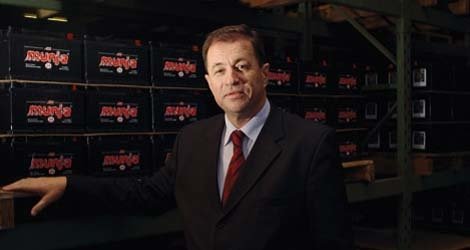
By entering Fiat, Munja would gain its ‘first installation’ with an automobile manufacturer, which opens a significantly broader and safer space in the market and ensures references.
Written by: Matilda Bačelić
[email protected]
Photo: Željko Jelenski
Under the hood of Fiat, Munja could soon find its place. Although the decision is not yet official, Zagreb’s Munja has entered the circle of ten suppliers that will be on Fiat’s list, as the only manufacturer of batteries and accumulators from the region. After entering Kragujevac’s Zastava, with which Munja has previously collaborated, Fiat began examining and verifying potential suppliers. The first round of verification is behind the Zagreb manufacturer, and the final decision, after a detailed audit, should be known in January. Unless the crisis cuts and stops everything in the automotive industry…
– We do not depend on Fiat nor do we build our strategy on it. If there is work, it will certainly mean a lot to us, but if there isn’t, we will live as we did before – says Ivan Miloloža, owner and CEO of Munja. By entering Fiat, Munja would gain, in automotive terms, its ‘first installation’ with an automobile manufacturer, which opens a significantly broader and safer space in the market and ensures references as the parts are on the manufacturer’s supply list. Contacts with the Volkswagen group, specifically Škoda, have been established previously, and recently there has been flirtation with Audi. The second installation represents a mass market where Munja is now fighting for a place in the sun, and a necessary condition for entering the European market is newly obtained quality certificates.
The biggest project and what Munja is building its strategy on is a new factory that could soon rise in the vicinity of Zagreb, more precisely in Brckovljani, where it will again be a neighbor to Elka. However, given the crisis that has halted almost all investments, the timeline could soon become very elastic. For now, Munja has purchased land, and the new factory is planned to be completed in the next two to three years. The value of the investment is estimated at approximately 10 million euros, and the capital for construction will be secured by selling some of Munja’s valuable real estate. By moving to a new modern factory, Munja expects to increase its capacity by one hundred percent and start competing with global players and, in the long term, consider acquisitions.
No exposure to banks
The greatest security and reason for the satisfaction of Munja’s owners are precisely the real estate whose value is constantly rising as the city expands. Thus, Munja will move for the third time in its 88-year history due to the expansion of Zagreb, and by repurposing the land in Žitnjak, where the factory is currently located, from industrial to business-residential zone and increasing the buildability of properties in Vrbanićeva and Heinzelova streets, due to the expansion of the business zone, the value of those properties has increased multiple times. How much it is at this moment is very difficult to assess, considering that it has not been revalued, but it is certainly much higher than the 30 million kuna stated in last year’s financial report. The owner’s decision not to accept numerous previous offers for the sale of those properties has proven to be more than ‘insightful’.
Numerous retail chains and builders have shown interest, as well as the City of Zagreb, which has not yet definitively stated whether it will enter this project or not.
– We do not care whether it is a private investor or the City. We are interested in any option that is profitable – says Miloloža.
Ina asks Munja to distribute through competitors
A few days ago, Munja received a notice from Ina that due to a change in strategy, they are reducing the number of suppliers and that from now on, they can sell their products in Ina’s network only through two distributors – C.I.A.K. and Rox. The problem is that these are not ‘independent’ suppliers, but distributors of Varta and Bulgarian and Italian brands of accumulators whose goal, as direct competitors and importers, is to reduce the presence of the only domestic manufacturer in the market. Ina is Munja’s largest buyer in the domestic market, so the expected exclusion from the offer at its gas stations would be a serious blow to the business.
Otherwise, Ina asked Munja a few years ago, says Miloloža, to distribute its products to Ina’s gas stations itself, which is why it had to invest in its own fleet.
On the Munja site in Žitnjak, which, along with the wider Kozari Bok zone, makes up 27 hectares, in addition to a school, kindergarten, and business skyscraper, as many as 1,835 new apartments should be built. Munja is marked as a city project, but the City of Zagreb has not managed to purchase 11 hectares on which the factory is located, where city fathers announced the construction of apartments according to the Zagreb model, but so far there is no concrete agreement. Miloloža did not reveal what the land price could be, although speculation has been around 500 euros per square meter, as, he says, they have never sought buyers nor formed a selling price.



