
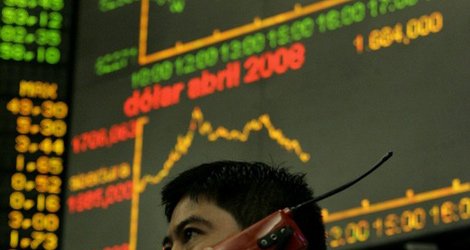
Stock prices on Asian markets sharply fell this morning following the news that the U.S. Senate did not accept the proposal for financial aid to the automotive sector, and the exchange rate of the U.S. dollar plummeted against the Japanese yen to its lowest level in 13 years.
On the Tokyo Stock Exchange, the Nikkei index fell by 5.6 percent today, and at one point was down more than 7 percent. The South Korean Kospi index dropped by more than 4 percent, while stock prices in Australia, India, and Singapore fell between 2 and 4 percent. Around 8 a.m., the leading index in Hong Kong was down 5.9 percent, while the MSCI index of Asia-Pacific stocks, excluding Japan, was down 5.4 percent. Investors across Asia were shocked by the news that the U.S. Senate did not accept the $14 billion aid proposal for the automotive industry.
Negotiations for this aid fell through as the United Auto Workers union did not accept the proposal from Republican representatives to sharply reduce wages next year to levels comparable to those in the Japanese automotive industry. The bankruptcy of any of the three largest U.S. automakers would mean a further significant rise in unemployment and a deeper slide of the U.S. economy into recession. General Motors, Ford, and Chrysler directly employ about 250,000 workers in the U.S. and approximately 100,000 more in their supplier network.
“If a company like General Motors initiates bankruptcy proceedings, which is the worst-case scenario, it could trigger a drop in the Dow Jones index below the 8,000-point level,” says Jackson Wong, a strategist at Tanrich Securities in Hong Kong. Yesterday, stock prices on Wall Street sharply fell precisely due to concerns regarding aid to the automotive sector. The Dow Jones index dropped by 2.2 percent to 8,565 points, and the S&P 500 and Nasdaq indices also fell by more than 2 percent. However, hope for aid to the auto industry has not completely faded, as the White House indicated that all possible options are being considered.
One of these options, analysts say, is to tap into the $700 billion fund intended for rescuing the financial sector. However, so far, the U.S. Treasury Department has rejected any notion of redirecting funds from that program to the automotive sector. After the Senate refused to support the aid bill, General Motors and Chrysler indicated that they are only weeks away from collapse but are considering all possible options. Ford, on the other hand, stated that they do not currently need government assistance, but the survival of the company is in question. All of this has significantly shaken the automotive sector across all Asian markets.



