
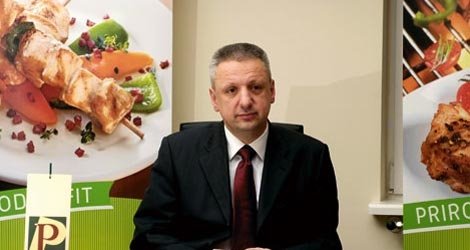
Predrag Šegović announces two revolutionary products in the chicken processing segment for spring. The problem will again be to explain to consumers that these are not products of Slovenian, but entirely Croatian origin.
Written by: Matilda Bačelić
[email protected]
Photo: Željko Jelenski
The entry of Gavrilović into the white meat market has brought a breath of change to a market where everything was simple and clear – Vindija’s Koka unchallenged reigns, Perutnina Ptuj-Pipo is calm and (un)happy in second place, while Puris is declining. Gavrilović’s purchase of Puris will not affect Koka, but the question is what will happen to Pipo? For now, there is no fear in Čakovec.
– Gavrilović will not threaten our position – says Predrag Šegović, CEO of Perutnina Ptuj-Pipo.
In the short term, it is objectively difficult to expect that. Puris is primarily a producer of turkey meat and processed products, so they are not direct competitors in the production segment since Perutnina in Croatia is exclusively engaged in the production of chicken meat and processed products. In processing and sales, the situation is different, and for Perutnina, a commercial relationship with Puris is particularly important, given that they are their third largest buyer of fresh turkey meat, which is sold through their network. Although the new owner of Puris has a solid trading network, it is hard to expect that they will give up selling to Perutnina, and thus indirectly to Konzum, given their own poor relations with the largest retail chain.
In the short term, the upcoming recession could have a greater impact on Perutnina Ptuj’s business, which will shake purchasing power and increasingly divert consumers from more expensive products. Namely, the poultry industry is generally low-profit, and processed products are what ‘pull’ it, on which higher margins are achieved. Currently, in Pipo, the ratio of fresh chicken meat production to processed products is in favor of fresh meat. Their desire, of course, says Šegović, is to increase the share of processed products. This year, they launched the Slim&Fit line in the premium segment, but it is questionable how the sales situation for such products will develop given the crisis. Setting up defenses against the recession, they began implementing rationalization in all segments of production and sales since summer.
The recipe for Poli is known only to two people
In any case, the goal for Pipo, which holds 20 percent of the Croatian market, is to maintain the second position. Its market share has, admittedly, remained at the same figure for several years, but Šegović says that the market is growing, so the share is increasing in absolute numbers. In fresh chicken meat, demand will likely continue to grow, unlike processed products, as it is the cheapest category of meat. However, this will adversely affect profitability growth. Last year, Pipo’s net profit margin was 2.7 percent, and the gross margin was 3.6 percent, making it slightly better than Koka (2.1 and 2.7 percent), which records incomparably higher revenue (1.2 billion kuna), but also a decline in profit last year (from 32.1 to 25.5 million kuna). However, the profit margins of both companies are lower than the average in the food industry.
Šegović expects that this year total revenue will exceed the ‘magic’ threshold of 300 million kuna, compared to last year’s 260 million kuna, but profits will be lower this year. How much lower, Šegović did not want to reveal for now, and the decline is based on rising raw material and input prices, which have peaked this year. In the cost structure of Pipo, and generally in the poultry industry, by far the largest part consists of distribution costs, given that it involves a special temperature regime, as well as energy costs. The announced increase in gas prices, along with other aspects of the global crisis, will therefore likely have a very unfavorable impact on next year’s business results.
The myth that Šegović persistently tries to break is that Pipo’s products are of Slovenian origin.
– Our raw material is completely of Croatian origin, and therefore we are larger Croatian producers than many so-called – says Šegović.
Imports of 41.6 million kuna, which was last year, were achieved, he says, through the import of breaded products produced in Slovenia. Exports nearly doubled last year, reaching 2.9 million kuna, but it is still a very small amount, achieved through exports to Macedonia.
Considering that Perutnina Ptuj as a group has a well-covered market of the former Yugoslavia with its own production, there is no need for exports to the region (exports to the EU are from Slovenia), although strengthening exports was announced as one of Pipo’s development directions a few years ago. The reason for not strengthening exports is also the fact that the Croatian market can easily absorb the entire current production.
– For Perutnina Ptuj-Pipo, it is necessary to raise the level of production because in this way it will be difficult to price competitively. Given that the owner does not invest significantly in the company in Croatia, and considering the very short distance between Ptuj and Čakovec, the continuation of production could be uncertain, especially after the fall of customs protections upon entering the EU – says Boris Teški, owner of the consulting firm Instar, adding that Pipo can hardly seek its future as a production facility, but has the greatest prospects as a regional logistics center for Perutnina Ptuj.



