Home / Media and Publications / Sanader: In 2009, the discussion may not be about salaries, but about jobs

Sanader: In 2009, the discussion may not be about salaries, but about jobs

The state budget for 2009, achieving an agreement between the Government and unions on freezing salaries, shipbuilding, and health reform are the first topics that will be addressed by the newly constituted Economic Council of the Prime Minister and the Economic-Social Council in the coming days.

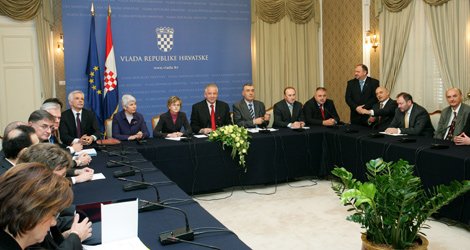
The first recommendation from today’s not only constitutive but also first working session of the Council relates to the alignment of positions of all public and state service unions regarding the Government’s proposal to freeze salaries. Instead of a meeting with Government representatives next Monday, the unions should agree on a common position and present it to the Government on Tuesday, while the Council will provide its opinion on the positions of both the Government and the unions on Wednesday, said Prime Minister Ivo Sanader, who is also the President of the Council, after the Council meeting.   

 The members of the Council are Ivica Mudrinić (President of the GSV), Sandra Švaljek (Economic Institute), economist Ante Čičin-Šain, Branko Grčić (Dean of the Split Faculty of Economics), Ljubo Jurčić (President of the Croatian Society of Economists), Dario Jurin (President of the Zadar County Chamber), Željko Lovrinčević (Economic Institute), Franjo Luković (President of the Management Board of Zagrebačka Bank), Žarko Miljenović (Chief Economic Advisor to the Governor of the HNB), Domagoj Milošević (Member of the Management Board of Croatian Exporters), Darko Tipurić (Dean of the Zagreb Faculty of Economics), Željko Turkalj (Dean of the Osijek Faculty of Economics), Anton Starčević (Chief Economist of RBA on behalf of HUP), Mladen Vedriš (Zagreb Faculty of Law), and Vilim Ribić (Representative of the Coordination of Trade Union Centers).

The Vice President of the Council, Sandra Švaljek from the Economic Institute, stated that there was a fairly unified stance at the Council meeting that freezing salaries is necessary, and that discussions about possible increases could take place once the situation develops in the first half of next year. Additionally, the Vice President of the Council, Ivica Mudrinić, emphasized the necessity to consider a system of linear salary increases, indicating that it is time for the Government to think about ‘restructuring’ the public administration.


Speaking about the challenges of the crisis that Croatia may face in the coming year, Prime Minister Sanader pointed out that there may no longer be discussions about salaries, but rather about jobs. By the end of next week, the Council will also be familiar with the contours of the budget proposal for 2009, and Švaljek highlighted that different views from representatives of all economic theories were overcome at today’s meeting, concluding that a zero deficit in 2009 is necessary.

Moreover, it was suggested to create certain reserves of budgetary funds, preferably a budget surplus. The Council also discussed the ‘British model’ of combating the crisis by stimulating consumption, but Sanader stated that it was concluded that this is not a good model for Croatia, as stimulating consumption would further increase imports, thereby jeopardizing the planned zero deficit.

He also called for each of the social partners and other stakeholders in society to take their share of responsibility, adding that this applies to public enterprises as well as local and regional governments, urging them that it is not the time for unilateral moves, such as salary increases, but rather for reducing the prices of utility services, which would help both citizens and the economy.

The Council also discussed HUP’s proposal to reduce fees for HGK, HTZ, Croatian Forests, etc., as well as a guarantee fund to assist entrepreneurs facing problems due to the crisis, better preparation for the 2009 tourist season, and other topics, on which no opinion was reached today, but will be on the agenda of future Council meetings. He added that we share the crisis with all of Europe, along with the additional challenge of completing pre-accession negotiations by the end of next year, in which, alongside the crisis, the fact that there is fatigue from enlargement in the EU and the crisis regarding the acceptance of the Lisbon Treaty are complicating factors.

In response to a journalist’s question about whether the Council discussed a possible request for assistance from the IMF today, Sanader said that there was no discussion about the IMF. However, he added, there are other options, there are other banks, but this will be discussed when the Council addresses the topic of fiscal and monetary policy. (H)

