
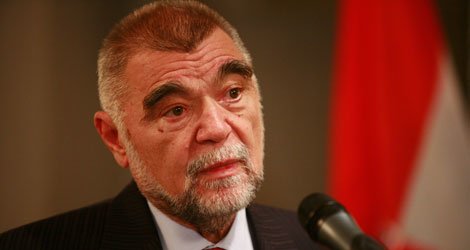
President of the Republic Stjepan Mesić stated today that Croatia must insist on the growth of production and exports as measures that will mitigate the impact of the global financial crisis on the situation in Croatia. He mentioned the funerals of veterans as one of the measures, in the context of the decision to pay military honors to all veterans at their funerals.
The President said that consumption in Croatia must not stop, as this would halt production as well. “If there is no consumption, we will stop production. We must not stop consumption. Plans are needed that will encourage production and exports,” Mesić said in the Croatian Radio program “With the President over Coffee.” In response to a journalist’s question to comment on Prime Minister Ivo Sanader’s statement that Croatia is “in a banana,” the President said that Sanader “wanted to express figuratively that things are not blooming for us” and that “we are also affected by the global crisis.”
Regarding the government’s plan of measures, he believes it is acceptable as a palliative measure, assessing that it is now necessary to move forward. Mesić stated that the Croatian economy needs “investments that will open jobs as early as tomorrow,” emphasizing that investments should be made “in production and exports, as that is the only thing that can save us.” He reminded that he was not taken seriously when he announced a possible crisis in Croatia at the Zagreb Fair, assessing that Croatia did not respond timely to those signs. There was no timely and serious response to the indicators, and probably prompted by what is happening, the Prime Minister wanted to figuratively warn people about the seriousness of the situation, Mesić said.
“The Prime Minister wanted to emphasize a bit more the dangers we are facing and the need to adopt measures that can help us overcome the crisis, which will last for some time,” he said, adding that the responsibility lies “with the government, which must help maintain our economy in foreign markets through measures.” Speaking about austerity measures, Mesić said that there are several infrastructure projects that can be discussed. Some, like the Zagreb airport, can be put out to concession, and regarding the Pelješac Bridge, it is necessary to determine “whether it is a priority” and how much has been spent so far, he said. If large money is needed for construction, we can freeze the construction and continue later, Mesić asserted, adding that it is necessary to connect Croatia, but it is not good to further burden the state with loans for that bridge. He also mentioned the funerals of veterans in the context of the decision to pay military honors to all veterans at their funerals.



