
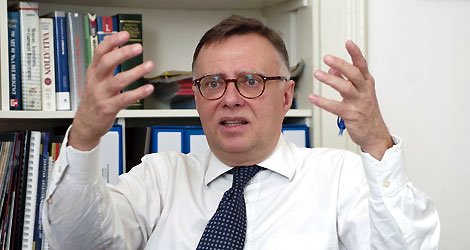
If Croatia does not allow the sale of 40 to 60 percent of apartments in tourist resorts, speculators will remain and international investors will not even come. Apartments will continue to be built in residential zones, while tourist zones will not develop further.
Interviewed by: Željka Laslavić
[email protected]
Photo: Dražen Lapić
Co-owner of the multinational company Falkensteiner & Michaeler Tourism Group (FMTG) Otmar Michaeler has been visiting Croatia every week for ten years, and we caught him just before the gala dinner at the Zadar hotel Club Funimation Borik, where he gathered collaborators on the Punta Skala project. Michaeler has doubted the profitability of investing in Croatia several times due to Croatian laws, and the economic crisis has contributed to this, which he considers an ideal opportunity for the Croatian government to change its approach towards large investors in tourism. The FMTG company builds and manages tourist complexes in 11 countries in Central and Eastern Europe, with 700 million euros in new investments, and its key markets are Austria, Italy, the Czech Republic, and Germany.
• The opening of the large Punta Skala resort was announced for this year’s summer season; however, we did not welcome it. How are things progressing and where has it stalled?
– The project is proceeding well, and we plan to open Punta Skala in June next year. For now, we do not plan anything new except for the completion of existing projects, namely Punta Skala, the construction of hotels and apartments in Punat on Krk, and, what is most recent, in 2010, we will sign a management contract for the facilities with Dino Motto, the owner of the Italian company that plans to invest between 50 and 60 million euros in the tourist resort Crvena Luka.
• The last time FTMG presented its projects in Carinthia, you expressed great dissatisfaction with the existing Croatian Land Law. Do you still believe that, given Croatian laws, it is not profitable to invest?
– We are still not satisfied with the Land Law, which prevents us from selling capacities in T2 tourist zones, and until the government changes that, we do not plan further investments. I agree that such a law was necessary at the beginning to prevent illegal construction, but I think it is time for serious changes in tourist zones. I believe that the time of economic crisis is the most suitable for attracting new investors and investing in mixed-use projects. In this way, 40 to 60 percent of the capacity in tourist resorts would consist of hotels, while the rest would be apartments with the possibility of sale, as is the case in Spain and Austria. With such a concept, the investor cannot sell apartments before completing hotel projects anyway. For me, this is a key point in the development of Croatian tourism. If Croatia does not change the law, speculators will remain, and international investors will not even come. Apartments will continue to be built in residential zones, and there will be no further development in tourist zones. If an investor invests about 50 percent of the capital in hotel construction and the rest in apartments, the total return on investment will be between seven and ten percent. Investors in Croatia, for whom tourism is not a core business, may achieve a return of four or five percent with excellent business, but that is not enough for our company.
• What exact consequences has the existing Land Law caused in the international investment market? How do foreign investors currently view Croatia?
– Croatia has lost very good opportunities. Four or five years ago, Croatia was a ‘hot’ market, but investors always encountered the same obstacle in tourist zones that I have already mentioned. Eastern European countries gradually opened up, and investors moved their capital there, just as we moved to the Serbian market, where we are building a hotel in Belgrade, then to Ukraine, Romania, and Bulgaria. However, if the law changes, they will return, but it should be noted that the financial market is no longer the same as it was five years ago. The new law must be structured in a way that is somewhat favorable to investors.
• What percentage of apartment sales would you be satisfied with?
– The best would be 50 percent.
• But you know that this is almost impossible?
– In Italy, that figure exceeds 50 percent. Twenty to 30 percent is no longer enough. But let it be 30, just let that process start already.
• Can we even count on new investors during such a crisis?
– Currently, it is very difficult times for investments because we do not know how consumers will react to the financial crisis. All ‘hot’ markets are gradually cooling down. For this reason, at the time of crisis, it is important to adopt a very clear new law because otherwise, very bad signals are sent to international investors. Without clear rules, banks will not give investors a single euro for tourist investments. Given the economic situation, FMTG does not plan to open new projects in the foreseeable future. We started building Punta Skala six years ago, and if we had started today, we would not have received funding for it. Investing in Croatian hospitality without mixed-use projects is not profitable for investors because business in Croatian tourism does not operate year-round. Bureaucracy is too slow; it takes a long time to issue the necessary permits. Croatia is not open enough to new investors. An investor should be a user of bureaucracy, not its problem.
• What do you think, how will the crisis affect Croatian tourism?
– If a very serious recession occurs, tourism will be in big trouble. We will lose the middle class of consumers, and there are no products for the high-class tourists in Croatia. Croatia is currently too expensive for what it offers. The only reason guests spend money in Croatia is that it has the most beautiful coastline in the Mediterranean.
• What is the reaction in the Austrian market? Can we expect a decline in arrivals from Austrians?
– Currently, Austria is working on the nationalization of banks, giving them, for example, two billion euros, remaining a shareholder for five years without interfering in their operations, and in return expects investments of seven billion euros in products and services from the banks. Interest in Croatia is declining in Austria; it is their closest seaside destination, but Austrians have realized that they do not receive the appropriate quality for the money invested. However, everyone somehow hopes that Croatia will work on this.
• What is your estimate for the next tourist season? How is your company preparing for a very tough battle?
– At this moment, we really do not know what to expect because we do not know what will happen in the economic market in the next six months. In the most ideal case, we expect results at the level of this year’s. In the four-star Borik hotel, the annual occupancy is around 73 percent, with a decent price, which we are satisfied with. It will be the season of opening Punta Skala, which we will only put into year-round operation in 2010, and we are counting on a good winter season due to quality wellness programs. For the needs of year-round operations, we will have to invest a lot in promotion in the Croatian and Slovenian markets, from which guests come by car, but also in all markets of the former Yugoslavia. Our usual investments in promotion amount to about five percent of total revenue, but for Punta Skala, we will invest between seven and eight percent.



