
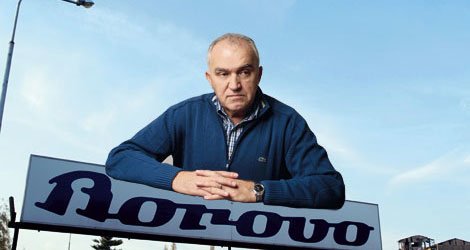
The development strategy set by the Management is based on building the future on its own brands, renewing and redesigning the retail network, selling assets outside Croatia, and activating unused land in Vukovar.
Written by: Matilda Bačelić
[email protected]
Photo: Željko Jelenski
“I have to bring my sons here to see the conditions under which good shoes can be made,” said the shocked Italian partner of Vukovar’s Borovo during a recent visit, as the hosts recount while leading us through the factory corridors of what were once huge industrial facilities that today mostly stand empty and destroyed. The parts that have been ‘squeezed’ for production, where around six hundred people work daily, often without basic conditions, do not give a much better impression. In the Borovo complex, on about 70 hectares of land, before the war, 17,000 people (out of a total of 23,000 employees) worked in more than 90 different activities. Borovo was a city within a city, as envisioned by the famous Czech shoe manufacturer Bata in the early 1930s, laying the foundations for an exceptionally well-organized industrial complex located along the right bank of the Danube. It was the second largest company in the former state, behind Ina. Today, it looks like a place where time has stopped or, at best, like a war museum. Although the war officially ended ten years ago, Borovo has long been a symbol of horrific war devastation rather than industry. It is enough to say that today’s Borovo is only four percent of what it once was, and the war damage is estimated at over 300 million euros. Nevertheless, remnants of leather and rubber shoe production have been smoldering since the end of the war, and the ongoing renewal of production facilities and plans for new investments give hope for recovery, survival, and perhaps even reaching a part of its former glory.
Calling for Privatization Without a Strategic Partner
Although the HFP does not know when the privatization of Borovo could begin, there are whispers in the factory circle that privatization is at the door. The Management is preparing an employee shareholder program for that moment, which would include current Borovo employees. The problem that could arise is the poor asset condition of those workers, so the question is how many would respond to the purchase of shares.
– “If the capital is reduced and the share price is acceptable, interest will be high,” says Vulić.
However, if workers had a representative on the Supervisory Board and better communication with the Management, Vulić adds, they could create a joint program. In any case, neither side wants their stores to be bought by some ‘strategic partner’ for one kuna.
Reliance on the Mid-Price Segment
Today, Borovo d.d., still 100% state-owned, consists of seven manufacturing, trading, and service companies and operates as a holding managed by Borovo-Business Center, which was established in 1992 to take on the role of the parent company during the years of exile. If nowhere else, optimism prevails in the office of director Mirko Ćavara, a long-time Borovo staff member who took the helm of Borovo in 2005. After years of stagnation, some money has started to flow into Borovo, which is the most important thing for things to start ‘happening’. The list of priorities is long – replacing old technology, investing in the brand, renewing production spaces, stores… The development strategy set by the Management is based on three key points – revitalizing the Borovo brand and building the future on its own brands, renewing and redesigning the retail network, and activating currently non-functioning capital, i.e., selling assets in some former republics and activating unused land in Vukovar. Current production in Borovo this year will reach around 250,000 pairs of leather shoes, 200,000 pairs of rubber and rubber-canvas shoes, and 1.5 million meters of industrial belts.
– “In the next two years, production should double,” says Ćavara, with the caveat that it depends on market reactions and how much can be invested in brand development.
– “We do very little contract work, and we would like to have none at all. Borovo stands alongside renowned global manufacturers in terms of knowledge and quality, but we work with inferior machines and materials,” he adds.
Borovo has realized that it best navigates the mid-price segment, which it will focus on, and in the future, once the consolidation of existing business and infrastructure is completed, it may seriously venture into fashion. In any case, the light motif of the new Borovo is its own brands, either through the revitalization of well-known old brands (as is currently happening with Startas) or through the development of new leather shoe brands such as the post-war brands Patrick, Stela, Navitas, the new children’s brand 2Cool, etc. In the segment of rubber footwear and technical goods, there are several products with NATO certification that can be developed.
Asset Sale Strategy
Through Borovo’s retail network in Croatia, more than a million pairs of shoes are sold annually, half of which are owned and half imported goods. Thus, Borovo finds itself in an interesting situation where, on one hand, as a manufacturer, it fights against cheap Chinese competition, while on the other hand, as a retailer, it imports it. Besides China, it imports the most shoes from Italy, from where the most materials also come. Ćavara also complains about the inability to enter large shopping centers, which are either too expensive or already reserved for competition from the country of the trader or investor, but Borovo can still take comfort in the fact that it still has many stores in city centers from the time it was a socialist giant. However, it cannot reach some of them. Compared to the former 620 stores, Borovo now has a network of 170 stores in Croatia, Slovenia, and Montenegro, where in 2003, the company Borovo-Monte was established to gain possession and control of its own business premises. However, such a scenario is not likely in Bosnia and Herzegovina, Serbia, and Macedonia, where Borovo still cannot reach its assets. In Macedonia, for example, the dispute has been ongoing since 1993 when the Macedonian company was established, which unilaterally declared itself the legal successor of Borovo. Therefore, Ćavara has opted for an asset sale strategy, especially in Serbia, where there has been a dispute with the company Boreli (which was part of the Borovo complex until 1990) regarding the sale of assets for years. So far, about twenty properties have been sold in Serbia, although the process is very slow due to disorganized documentation, which has brought in around five million euros.



