The wood industry is the only segment of production that has a positive foreign trade balance. However, what is currently happening with the exchange rate leads us to seek government assistance, which we cannot access. It is unacceptable that the government spent three months discussing whether Sunday should be a working day or not, while we here, with 40,000 employees, still have not had the opportunity to meet with them.
Interviewed by: Amir Kulenović
[email protected]
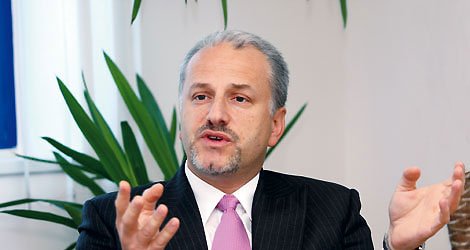
Photo: Ratko Mavar
The wood industry in Croatia, a sector that has traditionally been developed, especially in the rural areas of the country, has in recent years transformed into a branch that mostly produces and exports raw materials, and increasingly less finished products with some added value. Finvest, as a company that employs more than 1,000 workers in its two factories, in Čabar and Bosanski Drvar, is one of the larger companies in this sector. In addition to wood, Finvest has also stepped into tourism by purchasing a hotel resort in Njivice, and will soon open a factory for the production of wood pellets in Gorski Kotar, thus embarking on ‘green energy’ projects. We spoke with Finvest’s CEO Marin Filipović about opportunities in the wood industry, attempts to diversify the business, and motives for investing in other publicly traded companies (Finvest owns eight percent of Industrogradnja shares).
• Since last December, your father has entrusted you with the management of the company. What are your first impressions? – I must admit that my appointment was a great surprise to everyone, both due to my father’s very active participation in managing the company, regardless of his age, and due to a somewhat different way of thinking and doing business.
• Was that transition difficult?
– No, all the collaborators remained the same, we have a good team, and I believe that my way of managing the company is certainly much less emotional than my father’s way. I am not saying that the previous management style was bad – Finvest would not be where it is today if my father were not an exceptionally capable man, but we definitely differ in our approach.
• Are the recent moves towards business diversification your doing? – Finvest is de facto the largest processor of wood mass in the former Yugoslavia in the technical wood segment. We operate at three locations, two in Bosnia and Herzegovina, one in Croatia, and in addition, we have an additional vertical structure that connects through semi-finished products to final products. Wood has had quite a few fluctuations over the past years, and we saw that we should turn to something else.
• Why did you turn to tourism?
– Given that we had retained earnings, we thought about what would be compatible. We could not find anything in the wood industry segment that would attract us, so we opted for tourism because it is an export product. That is why we decided on the Njivice hotels, as one of the tourist companies that remained with a long-term undefined owner, although the owner was Rijeka Bank, from which we purchased a majority stake.
• Do you believe you have enough know-how for tourism? It is, after all, an activity that is quite different from the wood industry? – In the decision to purchase Njivice, we were guided by the relationship between price and the state of the company and the growth potential. By deciding on them, we had a good, compact management that worked in the three-star segment, and I believe we are a destination with good three stars.
• What are your further plans? Will you raise the quality of the offer?
– We want to raise one or two facilities to four stars, while leaving the rest at three. Demolishing the existing bungalow settlement that connects our hotels and building a new four-star one is a step in that direction. I believe that Krk can develop as a four-star destination, but the lack of content is problematic. That is why we were very interested in developing golf, as tourists in Krk have nothing to do in the off-season and winter.
• Why did you choose golf?
– I am a passionate golfer and I know their purchasing power. Moreover, it can be played ten to eleven months a year. With the proximity of Italy, Austria, and low-budget flights to Istria and Kvarner, the absolute goal should be the development of golf. We need to work on that.
• Has that project failed? – The problem is the unresolved issue of tourist land. We were interested, but putting ourselves in a situation where we invest in a project that can be halted by someone with their two thousand square meters is too risky. Depending on 300 plots is an impossible story. It turns out that it is a good thing that Albania exists, so we are not the only country in the Mediterranean that used to be without golf courses.
• Are Njivice the only interesting place for you on Krk?
– We hope to soon start more concrete discussions with the municipality of Vrbnik. Letters of intent have been exchanged, and we are interested in launching a new type of tourism there. These should be smaller hotels, but of a much more exclusive type. To get started, we are waiting for their green light. Vrbnik has almost no accommodation capacity, and I believe we have shown our long-term interest.
• What kind of investments are we talking about? – From three to twelve million euros until the final phase.
• When do you expect a response?
– Soon.
• Does this mean that investments could start at the end of this year or the beginning of next?
– We have already started working on conceptual solutions for the hotel, but given that Vrbnik is under certain conservation oversight, I doubt we will start building this year.
• You are soon opening a plant for the production of wood pellets in Gerovo?
– In the last year and a half, we have been upgrading the wood sector segment. We realized that with a daily cut of a thousand cubic meters of raw material in two countries, regardless of the relatively quick turnover of capital, Finvest cannot avoid the influence of external factors without new investments, which are the current conjuncture and unsustainable exchange rate policy.
• Do you think that expanding production in that direction will bring the desired effects?
– We hope that the plant will start operating in January next year. This is an investment that is very important to us, given that we will process the raw material that we are currently selling abroad. This is new added value, and a long-term investment, very capital-intensive and profitable in the long run.
• How much does that investment amount to?
– Approximately seven million euros was the total investment cycle in the wood segment of the business.
• In your hotels, are you planning a new pellet power plant and why?
– We see our calculation in that we use our own raw material for that plant, and the investment will reduce our energy costs, which, along with the unfavorable exchange rate, is one of the biggest obstacles to achieving higher levels of profitability. In addition, it would also be a showcase plant of that type in Croatia on renewable energy sources and the promotion of our own product and energy source.