
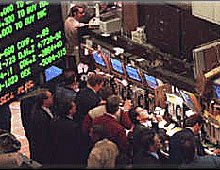
The collapse of several leading American financial institutions caused tremors on stock exchanges around the world last week, prompting the U.S. government to withdraw emergency measures to contain the financial crisis.
On Wall Street, the Dow Jones index plummeted 504 points or 4.4 percent on Monday. This was the largest daily drop of the index since September 17, 2001, the first trading day of the New York Stock Exchange after the terrorist attacks on September 11. By the end of the week, however, it reduced losses as investors felt relief after the announcement of new legislative solutions that the U.S. government plans to introduce to calm the crisis. These announcements spurred a strong rise in stock prices on Thursday and Friday, particularly in the financial sector. Nevertheless, throughout the past week, the Dow Jones lost 0.3 percent, closing the week at 11,388 points.
However, the S&P index rose 0.1 percent, to 1,255 points, while the Nasdaq index increased by 0.6 percent, to 2,273 points. A wave of shocking news last Sunday, after the negotiations among American financial powerhouses to rescue Lehman Brothers failed, severely shook investor confidence in the American financial system. The bankruptcy of Lehman Brothers and the emergency sale of Merrill Lynch, once the flagship of investment banking in the world, along with American International Group’s (AIG) desperate search for fresh capital to ensure survival, triggered a sharp decline in stock prices at the beginning of the week in the financial sector. The S&P financial sector index plummeted by as much as 10.6 percent on Monday. Trading on stock exchanges around the world was very nervous. Emerging markets were hit hardest, such as the Russian stock exchange, which was mostly closed for three days due to the worst stock price drop since the financial crisis of 1998. Investor fears during those days were not calmed even by the emergency loan of $85 billion from U.S. authorities to AIG, which saved one of the largest insurance companies in the world. Since the beginning of the year, Bear Stearns and Lehman Brothers have gone bankrupt, while Merrill Lynch was saved by an emergency sale to commercial bank Bank of America.
This means that three of the five largest American investment banks have ‘disappeared.’ Only Goldman Sachs and Morgan Stanley remain, leading investors to ponder whether these banks can survive in crisis conditions with their business models as independent investment banks without the support of a deposit bank. However, on Thursday, stock prices on Wall Street suddenly recorded the largest daily jump in six years. The euphoria was fueled by the announcement from U.S. Treasury Secretary Henry Paulson that a law aimed at resolving the problem of massive bad loans in banks would be presented to Congress early next week. The problem would be resolved similarly to how it was during the savings and loan crisis of 1989, when the Resolution Trust Corp. was established.



